
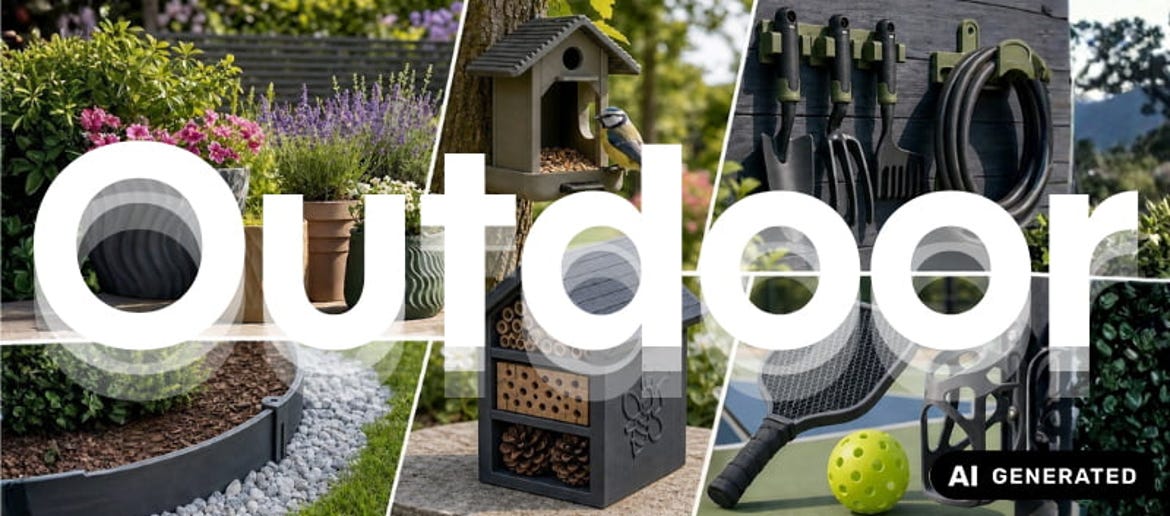
Outdoor-Ready Filaments for Weather-Resistant 3D Prints
A 3D print that looks great on a shelf indoors can quickly disappoint after just a few weeks outdoors: faded colours, brittle edges, the first signs of cracking. The reason is almost always the material. Standard PLA is affordable and easy to print, but it does not cope well with UV radiation, moisture or temperature fluctuations. Instead, it becomes brittle, loses its shape or discolours.
Outdoor-ready filaments such as ASA, PETG, PC and nylon are much better suited to outdoor use thanks to their material properties. They offer UV stability, weather resistance and mechanical strength, which is essential if a printed part is to remain stable and visually appealing outdoors for months at a time.
What can you print with outdoor filaments?
The applications are many and varied. In short, wherever a part is to be exposed to the sun, rain or cold, it is worth choosing a true outdoor material:
- Garden decorations: plant pots, plant markers, figures, birdhouses, insect hotels;
- Brackets & fixings: wall brackets for hoses and tools, cable clips, climbing plant supports;
- Signage: house numbers, name plates, information signs for the garden or patio;
- Technical components: housings for outdoor sensors, brackets for solar lights, spare parts for garden tools;
- Sports applications: brackets and accessories for outdoor sports equipment that need to withstand weather and mechanical stress.
The materials at a glance: strengths and weaknesses
► ASA – the all-rounder for outdoor use
ASA is regarded as the classic outdoor filament and is usually the first choice when UV resistance is the priority. The reason lies in its material structure: instead of the UV-sensitive butadiene rubber phase found in ABS, ASA contains a polyacrylate rubber phase that is naturally much more stable when exposed to UV radiation. This is precisely why ASA was originally developed for the automotive industry, where exterior parts need to withstand weathering for 5 to 10 years.
Outdoor performance in detail: In practice, ASA prints exposed to direct sunlight for several years show only minimal changes in colour and structure. Unlike ABS, ASA does not develop surface “chalking”, as the acrylate rubber phase is not subject to the same oxidative chain scission as the polybutadiene in ABS. Important: although ASA absorbs little moisture, it should still be dried before printing to avoid bubbling and surface defects.
|
Strengths |
Weaknesses |
|
|
Best suited to: garden figures, house numbers, brackets, technical housings, furniture parts and decorative elements that are permanently exposed to direct sunlight and need to retain their colour for a long time.
► PETG – robust and moisture-resistant, but with UV limitations
PETG is much easier to print than ASA and offers good basic properties, but with one important limitation that is often misunderstood: while PETG is often described as “suitable for outdoor use”, its resistance to UV radiation is only limited. The PET ester bonds are attacked by UV radiation through chain scission, which can lead to yellowing, clouding and a loss of tensile strength and elongation at break over time.
Outdoor performance in detail: Practical observations show that with intense sunlight, the first signs of yellowing in transparent or light-coloured PETG variants can often become visible after just 3–6 months. After 6–18 months, the surface may become noticeably cloudy or hazy. Dark, opaque colours delay this effect significantly, as less UV light penetrates deep into the material. Important for customers: PETG is better described as “weather-tolerant for a limited time or in partial shade” than “permanently UV-resistant”. For objects that are intended to spend many years in full sun, ASA is the safer choice.
|
Strengths |
Weaknesses |
|
|
Best suited to: plant markers, irrigation accessories, brackets in partial shade, parts with frequent moisture exposure but moderate direct sunlight, or as an affordable entry-level option with an additional UV-protective coating.
► PC (polycarbonate) – maximum strength, moderate UV resistance
PC is the right choice when the main priority is not pure weather resistance, but mechanical strength, impact resistance and heat resistance. In terms of UV resistance, PC sits between PETG and ASA: significantly better than PETG, but not quite at the level of ASA.
Outdoor performance in detail: Untreated PC is highly UV-permeable and begins to visibly yellow after around 2–4 months in intense sunlight, or after 1–2 years under moderate exposure. UV-stabilised PC variants, using HALS or benzotriazole absorbers, delay this considerably – depending on the formulation, to around 12–18 months under intense UV exposure or 4–5 years under moderate UV exposure. For permanent outdoor use, UV-stabilised PC should therefore be chosen specifically rather than pure PC.
|
Strengths |
Weaknesses |
|
|
Best suited to: mechanically demanding outdoor parts such as brackets for heavy objects, housings for solar equipment, tool holders or parts that need to withstand both impact and high temperatures – provided a UV-stabilised variant is used.
► Nylon – tough and hard-wearing, but suitable for outdoor use only with UV stabilisers
Nylon, or polyamide, usually PA6 or PA12, is particularly strong when it comes to mechanically demanding parts. It is important to note that standard nylon without UV stabilisers is not suitable for permanent outdoor use. It yellows, becomes brittle and loses strength under UV exposure. For outdoor projects, nylon with UV stabilisers should therefore be chosen specifically, as it has been specially additivated for this purpose.
Outdoor performance in detail: The biggest outdoor challenge with nylon is not only UV radiation, but moisture absorption itself. Absorbed water acts like a plasticiser between the polymer chains and measurably changes the mechanical properties. Tests on moisture-conditioned PA6 show a loss of stiffness down to as little as one third of the original dry value in some cases. PA12 is far less affected and is therefore the more suitable base material for damp outdoor environments. For true outdoor use, additional UV stabilisers are needed to counter photochemical yellowing and embrittlement. Pure, unstabilised nylon of any kind is unsuitable for this purpose.
|
Strengths |
Weaknesses |
|
|
Best suited to: moving or heavily stressed outdoor parts such as hinges, gears, rollers, tool components or spare parts for garden equipment – with a UV-stabilised formulation and, ideally, a PA12 base where moisture exposure is high.
| Note: All values are guide values based on manufacturer data sheets and material tests, and may vary depending on the product, print settings and part orientation. |
What really happens to the material under UV exposure
To understand why some filaments last for years outdoors while others start to crumble after only a few weeks, it is worth taking a closer look at the chemistry taking place inside the material itself.
Photo-oxidation as the real culprit
Sunlight contains UV radiation with enough energy to break chemical bonds in plastic molecules. Certain molecular groups within the polymer chain, known as chromophores, absorb this UV energy particularly readily. This creates free radicals, which react with oxygen in the air and effectively cut the polymer chains apart through chain scission or crosslink them uncontrollably. The result at the surface is discolouration, usually yellowing, embrittlement and microcracks. In materials science, this process is known as photo-oxidation and is the main cause of weathering damage in virtually all standard plastics.
Why ASA performs so much better than ABS
ABS and ASA are chemically very similar, but they differ in exactly the crucial area. ABS contains a polybutadiene rubber phase that is particularly susceptible to photo-oxidation, and this is almost always where degradation begins first. ASA replaces this component with a polyacrylate rubber phase, which is naturally much more stable when exposed to UV radiation. This is also why ASA was originally developed for the automotive industry, where exterior parts need to withstand weathering for 5 to 10 years. Standardised weathering tests such as ISO 4892 and ASTM G154 confirm this again and again: ASA retains its mechanical properties and colour significantly longer than ABS, PETG or PLA.
The vicious cycle with PLA
PLA has two points of attack at once. The ester bonds in the polymer are attacked both by UV-induced photo-oxidation and by hydrolysis, where absorbed moisture splits the bonds. The particularly problematic part is the self-reinforcing effect: as soon as the surface becomes more porous due to degradation, it absorbs even more moisture, accelerating the breakdown process further. Without built-in UV stabilisers, this explains why pure PLA prints outdoors often darken visibly within just a few weeks and become brittle after only a few months.
The role of UV stabilisers and HALS
Additivated filaments, such as UV-stabilised nylon or PC, usually contain HALS, or Hindered Amine Light Stabilizers, or UV absorbers. HALS capture the free radicals created during photo-oxidation before they can cause further damage to the polymer chain. In the process, they are chemically barely consumed at all, acting like a constantly active protective mechanism. UV absorbers work differently: they absorb the UV radiation itself and convert it into harmless heat before it can react with the polymer chain in the first place.
Why moisture plays its own role with nylon and PETG
Nylon is highly hygroscopic, meaning it absorbs moisture directly from the air. These stored water molecules act like a plasticiser between the polymer chains, changing the mechanical properties in addition to the UV-related issues. PETG absorbs less moisture, but without UV additives, UV stability remains its main weakness rather than moisture itself.
Why a protective layer really does protect the inside
From a scientific point of view, it is interesting that many plastics initially form a thin, degraded surface layer under UV exposure, which blocks oxygen and UV access to the material beneath. UV-protective coatings and impregnating agents deliberately make use of this principle: they create a stable artificial barrier layer before the base material itself is attacked, significantly delaying the start of photo-oxidation inside the part.
How to make your print truly outdoor-ready: the right post-processing
Even the best outdoor filament benefits from suitable post-processing, especially if parts are intended to remain outdoors for years. To make sure this is more than just good intention, here is a practical step-by-step guide showing which steps make sense and in what order:
Step 1: Prepare and clean the print
Before any post-processing, the print should be free from dust and grease. The best approach is to wipe it down with isopropanol. This removes fingerprints, release agent residues and fine dust that could otherwise affect the adhesion of paint or impregnating agents.
Step 2: Fill seams and uneven areas, only for multi-part prints
If the object has been printed in several parts and glued together, glue seams and larger gaps should first be filled with a filler. Once dry, lightly sand the surface, for example with 320–400 grit, to keep it even. This is important because moisture can later collect and penetrate exactly in these areas.
Step 3: Impregnate, especially with lower infill
If the part was not printed with 100% infill, which is the case for most outdoor objects for reasons of time and material use, impregnation is worthwhile before any painting is done. A low-viscosity impregnating agent such as DIAMANT Polymer dichtol AM UV Protection penetrates fine pores and transitions between the printed layers, seals them from the inside and also provides UV protection. This is the step many people skip, yet especially with infill below 100%, it is often more important than the layer of paint on top.
Step 4: Apply primer
Once the impregnation has dried, the primer is applied. It creates an even adhesive surface for the paint and additionally seals the print layers from the outside. A spray primer can be applied evenly and thinly. Important: use several thin coats rather than one thick coat, allowing sufficient drying time in between. Otherwise, the primer may run or attack the filament, especially with PETG and PLA.
Step 5: Apply colour, optional
If you want to add colour to the object, now is the time to apply the actual paint, either as spray paint or with a brush, depending on the desired finish and level of detail.
Step 6: Apply UV-protective varnish / clear coat as the final layer
Finally, apply a UV-resistant clear coat, either gloss, satin or matt, depending on the desired look. This final layer is what actually protects the colour from fading. Without it, even the most attractive paintwork will fade over time, regardless of the base material.
Practical tips for all steps:
- Always work in dry weather and at moderate temperatures, around 15–25 °C, otherwise coatings and impregnating agents may dry unevenly.
- Allow sufficient drying time between coats. Follow the manufacturer’s instructions, usually at least 30–60 minutes and longer for thicker layers.
- Take care with solvent-based sprays on PETG and PLA. A test on an inconspicuous hidden area will show whether the material is affected.
- Check the protective layer every 1–2 years and reapply treatment at the first signs of weathering, rather than waiting until the base material itself has been attacked.
Conclusion
There is no single perfect outdoor filament. The right choice depends on the application: ASA for UV-intensive areas, PETG for a good balance of easy printing and moisture protection, PC for maximum mechanical strength and nylon for tough, heavily stressed parts. With the right post-processing – UV clear coat, impregnation or primer – you can get the maximum outdoor service life from each of these materials.
What is changing, however, is that the old rule of thumb: “ASA yes, PETG, PC and nylon only with caution” is becoming less clear-cut. More and more manufacturers are now developing specially modified, UV-stabilised versions of materials that were once considered unsuitable for outdoor use.
- UV-stabilised PETG with a special UV additive package is now available in its own right as a certified UV-resistant material - a clear difference from standard PETG, which yellows over time without such additives, as described in the material comparison.
- Glass fibre and carbon fibre reinforced ASA variants, ASA-GF/CF, combine the UV stability of ASA with higher stiffness and reduced warping.
- Lightweight or foaming ASA, LW-ASA, expands during printing and reduces both weight and material consumption while retaining UV resistance.
- UV-stabilised PC and nylon grades with HALS or benzotriazole additives are increasingly closing the gap that previously only ASA could fill.
What this means when choosing a filament: the material name alone, such as “PETG” or “nylon”, is no longer the reliable guide it used to be. The exact product and its data sheet are becoming much more important. A PETG labelled as “UV-resistant” can now match standard ASA in certain applications, while a low-cost ASA without clear manufacturer specifications will not necessarily perform better than a high-quality, UV-stabilised PETG. Our advice: for outdoor projects, look beyond the material name and check for details such as “UV-stabilised”, “weather-resistance tested” or references to relevant standards, for example ASTM G154 or ISO 4892. These details give a more reliable indication of outdoor performance than the material type alone.
Frequently asked questions about outdoor filaments
► Is PLA suitable for outdoor use?
Standard PLA is not recommended for permanent outdoor use, as it does not tolerate UV radiation and moisture well over time and becomes brittle. It can work for short-term or protected applications, but for long-lasting garden decorations or technical parts outdoors, ASA, PETG, PC or nylon are the better choices.
► Which filament has the best UV resistance?
ASA is generally considered particularly UV-stable and is therefore usually the first recommendation for parts that are permanently exposed to direct sunlight.
► Do outdoor filaments need additional treatment?
Not always, but it is recommended. Additional UV sealing or impregnation noticeably extends service life and colour stability, especially in intense sunlight or changeable weather.
► Which material is best for technical outdoor components?
For mechanically demanding technical parts, PC is often the most robust choice thanks to its high impact and heat resistance, ideally combined with a UV-protective treatment.
Related products
-
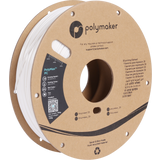
Polymaker Polymax PC White, 1.75mm (750 g)
- Tougher than a normal PC
- Temperature resistant up to 110 ° C
- Great mechanical properties
-
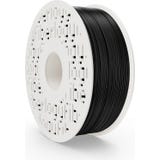
Fiberlogy Nylon PA12 Black, 1,75 mm / 1000 g
- Temperature resistant
- For technical applications
- Extremely durable
-
-
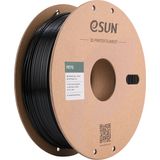
eSUN PETG Black, 1.75 mm / 1000 g
- High clarity & high gloss
- High chemical resistance
- Excellent impact resistance
Magazine Articles:
Discover 3DJake:
-
Delivery in 3 business days.
More than 11.250 products
We deliver worldwide to
more than 40 countriesSecure payments
with SSL encryption technology
